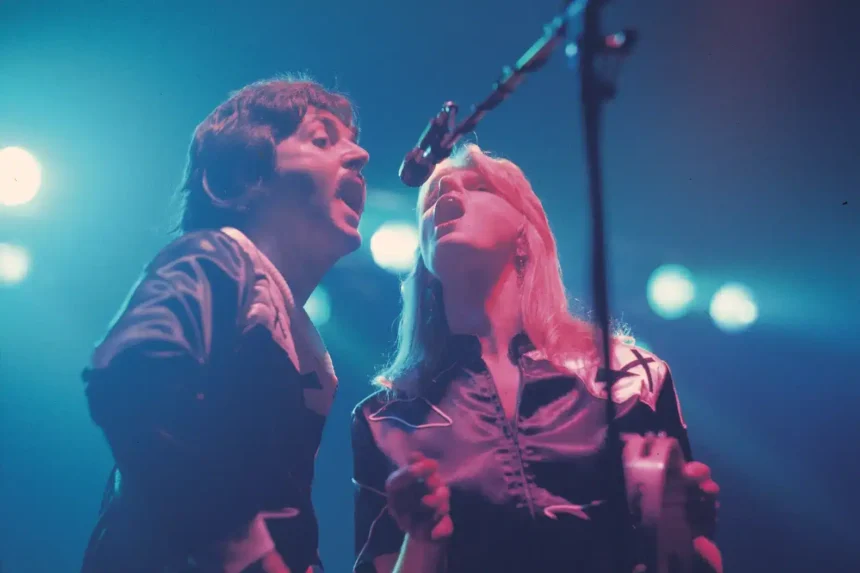
Paul McCartney and Wings played the first of three nights at Wembley’s Empire Pool on October 19, 1976. The London shows closed the Wings Over the World tour and captured a band that could carry an arena on the strength of its own songs. Fifty years later, the set also tells the story of how McCartney made room for the Beatles again.
After “Call Me Back Again,” Paul McCartney told the Wembley audience he was about to go back a few years. He joked that the next number was for anyone over fourteen, then played “Lady Madonna.” The song had come out in 1968, after the Beatles had stopped touring. For many people in the room, the familiar opening came with an unfamiliar sight: one of its writers was there to play it in front of them.

The October 19 show was the first of three at the Empire Pool. By the time the band walked off on October 21, it had completed 62 dates in roughly thirteen months. The five musicians at the centre of the Wembley lineup were Paul McCartney, Linda McCartney, Denny Laine, Jimmy McCulloch and Joe English. A four-piece horn section gave the songs room to expand without obscuring the band that had spent the previous year playing them.
Robin Denselow had an unusually good vantage point from which to judge the change. The critic had seen Wings in Ollioules, France, in 1972 and found the performance dispiriting. That earlier show took place outdoors, on a much smaller scale. The fledgling band drew largely on “Wild Life,” its 1971 debut, and the Beatles’ songs stayed out of the set. Denselow heard a group still trying to fit its parts together and was particularly critical of Linda’s performance.
Those early shows gave Paul McCartney somewhere to learn how to perform after the Beatles. He wanted Wings to be judged as a band, which meant putting the new material in front of people who had ample reason to ask for the old songs. In 1972, the recent album supplied much of the material available for that experiment. By 1976, the decision about which catalogue to draw on had become easier because Wings had a catalogue worth drawing on.

“Band on the Run,” released in 1973, gave them a title song that could anchor a set, the blunt forward motion of “Jet” and the long guitar line of “Let Me Roll It.” “Venus and Mars” brought another batch, including “Listen to What the Man Said” and “Call Me Back Again.” On the road, those recordings became the material from which Wings could build the pace of an evening.
The world tour started in September 1975 and took Wings through Europe, Australia and North America. “Wings at the Speed of Sound” arrived while the tour was in progress and added “Silly Love Songs” and “Let ’Em In.” The North American dates were a return for Paul McCartney to a touring market he had last visited with the Beatles. In London, the accumulated work was audible from the start of the show.
“Venus and Mars/Rock Show” ran into “Jet” and “Let Me Roll It.” “Maybe I’m Amazed” and “Call Me Back Again” followed before the set made its first trip into the Beatles’ catalogue. The sequence put “Lady Madonna” in the middle of music McCartney had written or recorded since leaving the band. The return to the earlier song felt like a choice he could make once he had established what Wings sounded like that night.

“The Long and Winding Road” followed in a sparer setting than the version on “Let It Be,” where Phil Spector’s orchestral additions had filled out the recording. Later, in the acoustic stretch, Paul McCartney returned to the Beatles with “I’ve Just Seen a Face” and “Blackbird.” The change of scale let the audience hear those songs as pieces of a working set, between numbers the band had brought with it from other places.
Denny Laine sang Simon & Garfunkel’s “Richard Cory” and returned to his own past with “Go Now,” a song he had sung with the Moody Blues. Linda introduced “Live and Let Die” with a reference to a British agent numbered 007. The variety of those turns gives a sense of what Denselow heard at Wembley. Reviewing the show, he admired the playing and came away with a renewed appreciation for McCartney as a songwriter.

At the Empire Pool, keeping those songs in the programme also gave the younger section of the audience a way into a history it had mostly heard on records.
The final stretch included “Band on the Run,” “Hi, Hi, Hi” and “Soily.” Weeks later, the triple live album “Wings Over America” drew on the American leg, as would the concert film “Rockshow.” Wembley had been the tour’s last stop. The recordings that followed preserved a band with enough songs of its own that five Beatles numbers could take their places in the evening without having to carry it.