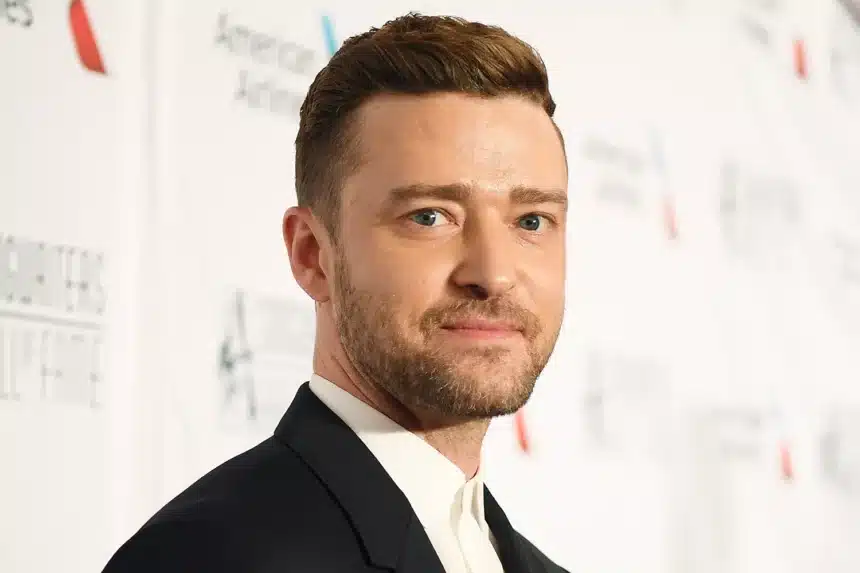
Justin Timberlake says “What Goes Around… Comes Around” grew out of a conversation with a friend about a breakup. In a November 5 interview, he addressed the longstanding assumption that the song was about his relationship with Britney Spears. Timberlake recalled asking permission to use his friend’s story and writing the song in about 20 minutes, before it became one of his biggest solo hits.
The title came from a conversation Justin Timberlake was having with a friend. The friend was describing a difficult breakup, and Timberlake heard something in the account that he wanted to use in a song. He says he asked first. In his recollection, his friend gave him permission and used the expression that would become the title of “What Goes Around… Comes Around.”

Timberlake brought up the story while ranking songs from his catalogue in an interview published on November 5. He said there was a rumour he had been meaning to clear up. The song had often been interpreted as a continuation of the public story about his relationship with Britney Spears. In his account of the writing, the experience that set it in motion belonged to somebody else.
The friend was unnamed in the interview. What Justin Timberlake chose to remember publicly was the way the conversation moved from a breakup to a phrase with the shape of a song title. He said the writing took about 20 minutes. The figure describes how he remembers composing it, a different part of the process from building the finished recording with the people credited alongside him.
The track appeared on FutureSex/LoveSounds in 2006. Timberlake, Timbaland and Danja were involved in its production, which gave the composition a scale it could not have had when it was still an idea from a conversation. On the album, the track is presented with its “Comes Around” interlude, giving that closing passage a place in the title as well as the arrangement. The released recording moves through different sections and has space to develop after the central refrain. In the recent interview, Timberlake counted it among the two best songs he had made.

The record reached No. 1 on the Billboard Hot 100 in March 2007. Its video, with Scarlett Johansson, also gave listeners a full story to associate with it. Justin Timberlake recalled the extended shoot and the way the song and the images developed together. The dramatic treatment supplied details of its own, making it easy for viewers to remember the single through the characters on screen as well as the voice on the record.
People had reasons for making the connection to Spears even without knowing anything about the session. The two had dated from 1999 to 2002. Timberlake’s “Cry Me a River” appeared in 2002 and became part of the public conversation about their breakup, especially after a video featured a woman whom many viewers thought resembled Spears. The association was established years before the second song came out.
The two tracks belong to different albums. “Cry Me a River” appeared on Justified, Timberlake’s solo debut. “What Goes Around… Comes Around” was on his follow-up four years later. Their shared vocabulary of betrayal and consequences gave listeners a reason to connect them. Once an audience has fitted one record to a public relationship, it can be tempting to hear a later song as the next chapter.

Spears addressed the earlier period in her 2023 memoir The Woman in Me. She wrote about the effect of a public account in which she felt she had been made responsible for the breakup. Her recollection concerns how that coverage and the video for “Cry Me a River” were received. Justin Timberlake’s recent comments address the source of a different song. They offer his recollection of its writing, which is narrower than a response to the memoir.
What changes with his explanation is where the writing starts. The singer remembers someone close to him describing a situation in private. He asked to borrow the story and took a phrase from the reply. That sequence gives the title a source before it had a melody, a production or any connection to the audience’s interpretation of what the record meant.

The interview also shows why the song remains important to him even when the speculation has persisted. Justin Timberlake talked about the relationship between its parts, the recording and the video, as well as the way the idea arrived. Those were the details he returned to when asked to place the track among the songs he valued most from his own career.
For listeners, the song has had almost two decades to gather associations of its own. The new account gives them one they could not have known from the video or the chart run. Justin Timberlake remembers recognising the title in a friend’s reply and having the song take shape soon afterwards. That was the moment he wanted to put on the record when he raised the subject again.