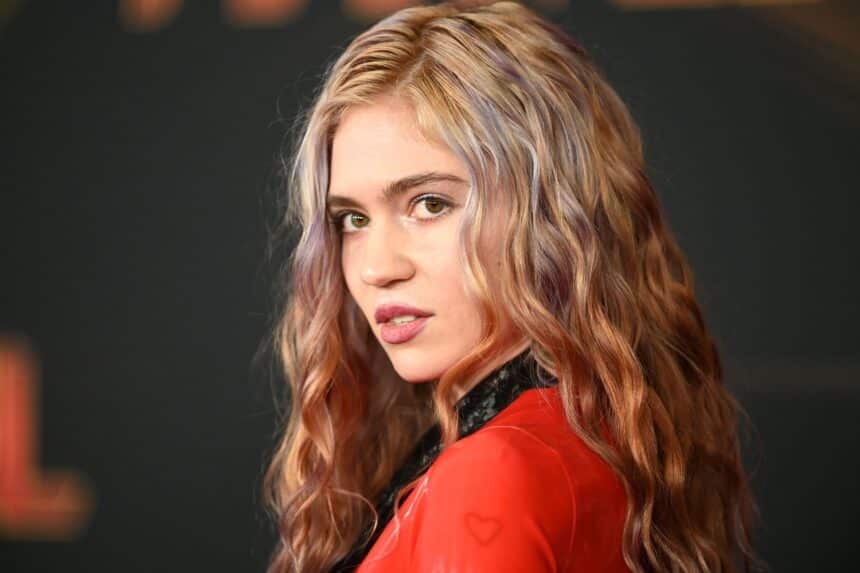
Grimes is making her film debut in “Gods Don’t Give Gifts,” a science-fiction feature built with AI-generated imagery. The musician supplies her own voice and likeness for Zayinth Alda, a digitally designed aristocrat in a world where consciousness can move between bodies. A newly released clip introduces the character ahead of a limited US theatrical release scheduled for December 4, 2026.
Grimes has entered a fictional society in which memories can be traded and the human mind is no longer tied permanently to one body. In “Gods Don’t Give Gifts,” her screen presence is digital, but her performance is not a synthetic recreation of her voice. The musician recorded the character’s dialogue herself. The distinction is central to a production that brings a recognisable artist into an environment created with generative imaging tools.

Her involvement was announced on November 5, accompanied by a clip introducing Zayinth Alda. The character is a disillusioned aristocrat within NiiroCore society and the niece of Caen Halvorith, the creator of the Substrate Migration Protocol. Within the story, that technology is connected with the transfer of consciousness. The family relationship places her close to one of the forces shaping the film’s imagined social order, although the preview offers only a small glimpse of that larger structure.
The scene shows her reacting with open contempt to another character before leaving with a large, muscular creature whose face has no recognisable features. She then heads towards a futuristic spacecraft. It is an introduction built around attitude and visual strangeness, giving the audience a sense of the character without explaining the full role she will play. The extent of Grimes’s involvement across the completed feature has not been revealed by the clip alone.

Zayinth’s appearance was digitally generated using the singer’s likeness as a reference. Her spoken lines, however, come from an actual recorded performance. Describing the character simply as an AI version of the artist would miss that division of work. The film combines a human contribution with a computer-generated visual representation, rather than presenting dialogue manufactured entirely by a voice model without the performer recording it.
Director Zack London, known online as Gossip Goblin, is behind the project, which is associated with that creative venture and Fable. His work has developed through science-fiction videos that use newer digital production techniques. “Gods Don’t Give Gifts” extends that approach into a feature intended for cinemas. The shift changes the scale of the undertaking, moving beyond individual online sequences towards a sustained story that has to hold together over a much longer running time.
The setting is NiiroCradle, a world in which technological change has altered the relationship between people, bodies and memory. Consciousness can be transferred, recollections can be bought and sold, and death may no longer represent a final ending. Such possibilities create questions about identity alongside new ways to exercise power. The film’s premise asks what might happen when experiences that seem inseparable from a person become assets that can circulate within a wider system.
Four interconnected stories explore that world. They share characters and ideas while looking at different consequences of trying to overcome the limits of the body. Grimes appears within this broader structure rather than being presented as the sole lead of a conventional single-character narrative. The approach allows the filmmakers to move between perspectives, tracing how the same technological reality might affect people in different social positions.

The use of generated images does not mean that the production involved no human creative labour. Writers, voice performers, musicians and technical collaborators contributed to the feature. The visual component is the part made with AI systems. Keeping those roles distinct matters when assessing the project, because the phrase “AI film” can otherwise suggest a process in which a complete work appears without performances, writing, editing or other decisions made by people.
Fable presents the collaboration as a possible model for artists lending their voice and appearance to animated characters. That is the company’s view of what such partnerships could become, rather than proof that the approach is already an established industry standard. Grimes has previously shown an interest in the creative uses of artificial intelligence, including arrangements allowing a digital version of her voice to be used in music under specific distribution terms.
The announcement also arrives as Grimes prepares the album “Psy Opera,” whose themes include artificial intelligence, consciousness and the changes brought by emerging technologies. Those concerns connect the film role with questions she has explored in her music and public statements. They do not settle the wider arguments around creative rights or payment, but they help explain why this particular fictional world fits her artistic interests. In this instance, she has chosen to contribute her own recorded interpretation to the character.

The producers have also promoted the feature with a claim about being the first entirely AI-imaged film heading to cinemas. That description should be understood as their own positioning, rather than an independently established historical first. The announced plan is a limited US theatrical release on December 4. Whether this method will secure a wider place in filmmaking remains open. For now, the clip offers the clearest evidence of Grimes’s contribution: a real vocal performance embodied by a digitally constructed character.