U2 paid tribute to Brian Eno with a secret concert at London’s Tate Modern on November 3, performing for around 400 people in The Tanks. His “77 Million Paintings” filled the walls as the band revisited familiar songs and delivered three live premieres. The evening ended with Eno joining them onstage, shortly before the release of their new album on November 13.
U2 exchanged the scale of a stadium for the concrete walls of an underground art space on November 3. The Tanks at Tate Modern held around 400 spectators for a secret London performance dedicated to Brian Eno. It was an unusually close setting for a band associated with vast audiences and elaborate productions. Here, the surroundings placed the musicians within a visual artwork and brought the focus back to a creative relationship that has shaped several chapters of their recording career.
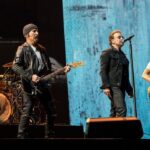
Guests learned the location only a few hours before the start. Admission had been arranged through a ballot, and phones were locked away in special pouches. The performance was filmed for the BBC, with a television broadcast planned for later in November. The small audience therefore experienced something deliberately contained in the room, while the recording was intended to give other viewers a route into the evening at a later point.
Bono jokingly described the space as an aquarium. Noel Gallagher and Lily Allen were among those attending, while art students sat on cushions close to the stage. The arrangement was far removed from the distance between a band and spectators in the upper tiers of an arena. It also suited a venue more commonly associated with experimental installations, allowing the audience to encounter the music as part of a shared visual environment.
That environment was created by Eno’s “77 Million Paintings,” first presented in 2006. Its changing combinations of colours and forms spread across the walls while U2 played. The visual work was more than decoration for an unrelated show: the evening repeatedly returned to the person being honoured. Bono reminded the audience of the purpose of the gathering, placing the music within a longer history of collaboration and experimentation.
Eno’s work with the band includes albums such as “The Joshua Tree” and “Achtung Baby.” His contribution helped encourage searches beyond established formulas, and all eleven songs performed at Tate Modern had a connection with him as a producer or co-creator. That provided the programme with a clear thread even as it moved between periods. It was a selection organised around a relationship rather than simply a compressed run through the best-known singles.
“Bad” returned early in the evening, having not been played live by the band since 2019. It had also been absent from the Las Vegas Sphere performances. In The Tanks, the song reappeared within a much smaller frame, without the scale of an arena between singer and listener. For U2, the revival gave a familiar recording a fresh place in a programme otherwise looking both backwards and towards new material.

Three songs received their live premieres: “Can’t Stop Us Now,” “The Greatest Show on Earth” and “COEXIST.” The first two come from the forthcoming “Carnaval de Luz,” while the third is from the “Easter Lily” EP. The concert was therefore more than a retrospective tribute. The audience also heard music that had not previously been tested in front of a live crowd, adding an element of discovery to an evening built on decades of shared history.
The presence of all four members carried its own significance. Larry Mullen Jr. had missed the 2023–2024 Las Vegas shows because of health problems, but joined Bono, The Edge and Adam Clayton at Tate Modern. Their performance of “The Greatest Show on Earth” brought the guitar, bass and drums into a compact setting. The night offered a view of the complete band ahead of the next phase of its live activity.
Bono also told stories connecting the music to other artists. He recalled Louise Bourgeois, whose “Maman” had appeared in the Turbine Hall when Tate Modern opened in 2000, and a visit during which he sang “Amazing Grace” to her. Before “In a Little While,” he shared a memory involving Spanish wine recommended by Eno and a difficult morning afterwards. These interludes gave the programme a conversational rhythm alongside its musical performances.

The forthcoming record is U2’s sixteenth studio album and their first full release of new material in nine years. It follows the “Days of Ash” and “Easter Lily” EPs, while plans for a major 2027 tour bring the four members back into a larger live setting. The Tate Modern concert should not be read as a complete preview of that future production. Its purpose was more specific: U2 gathered songs connected with Eno and presented them within an evening shaped around his contribution.
“The Unforgettable Fire,” “MLK,” “Pride (In the Name of Love),” “One” and “Beautiful Day” also appeared. The most direct gesture of gratitude came during “With or Without You,” when Bono found Eno in the room and invited him onstage to receive applause. He joined the band to be thanked rather than to perform. With “Carnaval de Luz” scheduled for November 13, U2 closed the intimate night by acknowledging a collaborator whose influence runs through both their history and their continuing search for new ideas.