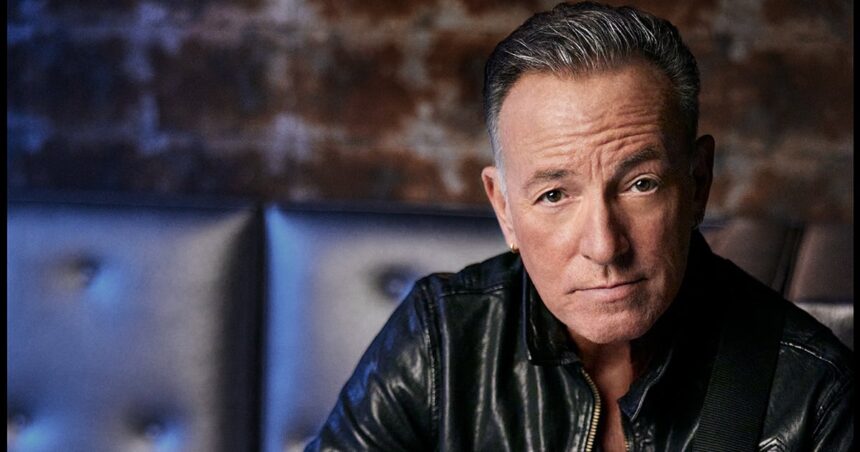
Bruce Springsteen has explained why he sees music and politics as connected, recalling the 1960s and the anti-war benefit concerts he played as a young musician. Speaking on “Home of the Brave Backstage”, he described rock as an expression of freedom. He also stressed that political engagement is not an obligation for every artist, recognising different ways music can influence society and reach listeners.
Bruce Springsteen does not regard the connection between music and politics as a recent development. In an interview for “Home of the Brave Backstage”, he returned to the years when he began playing in bands and explained why speaking publicly about society felt like a natural part of his work from an early stage.
The conversation was recorded in Maryland on October 3 and released towards the end of the month. Springsteen said that, for him, music and politics had always been connected on some level. His explanation drew on rock and hip-hop as expressions of freedom, rather than arguing that every composition must contain a specific political message.
He was interested in an artist’s ability to speak openly, describe personal experience and ask questions extending beyond private life. That understanding allows music to enter public discussion in several ways. A performer might address an issue directly, or make an experience audible that otherwise receives little attention, without treating every song as a statement of policy.
Bruce Springsteen traced that outlook to growing up during the 1960s, when social movements helped shape public life. He remembered music forming part of discussions about war, rights and the country’s direction. For many people of his generation, a musician’s participation in those debates did not necessarily appear unusual or separate from the rest of their responsibilities.
His own memories included playing in local bands before achieving international recognition. In 1972, he took part in benefit concerts raising money for people protesting against the Vietnam War. He also voted for the first time that year. The two recollections described a period in which musical activity and political awareness were developing alongside one another.
In that environment, having a public voice brought an expectation that it could be used. Bruce Springsteen described no strict dividing line between the person appearing onstage and the citizen concerned about events around him. A concert could provide money for a cause, a meeting place or an occasion for protest, as well as a musical performance.
Those experiences helped shape the role he has chosen for himself. They were presented as an explanation of how he arrived at his position, rather than a claim that every performer must reproduce it. The distinction became clearer as he turned from his own beginnings to the different forms of influence available to other musicians.
Speaking with Ken Casey of Dropkick Murphys, Springsteen also discussed his relationship with American identity. He described loving his country while seeing a distance between its possibilities and the circumstances people actually experienced. His work, as he explained it, has tried to bring that distance into view, making lived experiences part of a wider conversation.
Bruce Springsteen did not present songs as a solution to political problems. Instead, he described their capacity to raise questions about being American and about a person’s responsibility towards a community. The emphasis was on attention and understanding: allowing an audience to hear about conditions or experiences that might otherwise remain outside its immediate view.

He also accepted that music can simply be entertaining. Listeners need not search for political meaning in every line for a song to have value. His point concerned what an artist may choose to do through music, leaving room for enjoyment and for work that does not explicitly address an argument, a public controversy or a social issue.
That flexibility extended to his fellow performers. Bruce Springsteen said he did not necessarily believe every artist had to be political. He named Elvis Presley, James Brown and Curtis Mayfield as musicians whose expression and performances had deeply affected society, comparing their cultural influence with Woody Guthrie’s more direct relationship to political songwriting.
The examples widened the discussion beyond public statements or endorsements. A musician’s impact can come through what is sung, how it is performed and what an audience encounters in the work itself. Springsteen’s distinction allows for different artistic choices while explaining why he has repeatedly chosen to connect his own writing and public voice with the world outside the stage.
The interview opens the “Home of the Brave Backstage” series, whose hosts also include Michael Fanone and Sarah Longwell. It was recorded around the “Power to the People Festival” in Columbia, Maryland. Announced future conversations include Joan Baez, Public Enemy’s Chuck D and Foo Fighters’ Chris Shiflett, exploring their individual views on participation and public expression. The series places those views within personal conversations, allowing each guest to explain the experiences behind their position.
Towards the end, Bruce Springsteen returned to the importance of holding on to hope during difficult social conditions. His own choice remains to speak about what he considers significant, without demanding an identical stance from every musician. Even when political circumstances cause disappointment, he argued, hope remains necessary to the way a person faces them.
IMAGE_CREDIT: Home of the Brave