Beyoncé’s Super Bowl XLVII halftime show brought thirteen minutes of choreography, lighting and familiar songs to New Orleans on February 3, 2013. Its most recognisable surprise arrived when Kelly Rowland and Michelle Williams joined her, briefly reuniting Destiny’s Child. Thirteen years later, the performance remains a clear example of how a tightly timed television production can connect an artist’s solo career with an earlier musical partnership.
Beyoncé took the stage at New Orleans’s Mercedes-Benz Superdome on February 3, 2013, with roughly thirteen minutes to present a career spanning group success and solo stardom. The Super Bowl XLVII halftime show needed to work for spectators in the stadium and millions watching television. Her response combined vocals, demanding dance sequences, a female band and a sharply organised selection of recognisable songs.

An introduction drew on “Run the World (Girls)” before the singer appeared amid flames and strong lighting. Brief lines from “Love on Top” led into “Crazy in Love”, whose familiar horn figure launched the main dance section. Dressed in black, she moved with her dancers while the production gradually revealed a larger visual setting around the central performance.
“Crazy in Love” connected the occasion with the beginning of Beyoncé’s solo recording career in 2003. A decade later, it remained one of her most identifiable live numbers. Its place early in the programme established that history quickly, using a familiar musical entrance while the performance demonstrated the physical control and camera awareness she had developed through years onstage.
The transition into “End of Time” and “Baby Boy” expanded the interaction with musicians, dancers and projected images. Changes in rhythm required corresponding shifts in choreography, while multiple visual versions of the singer appeared around the stage. Each section had to establish its identity quickly before making room for the next, with little time available for extended introductions or pauses.
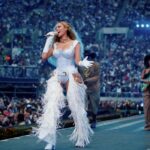
Lighting helped connect those rapid changes. Flames, illuminated lines and large projections gave individual sections different environments without requiring the show to stop. Television shots moved between wide views and closer images, allowing the scale of the design and the details of the choreography to remain legible. The stadium performance and the broadcast depended on the same carefully coordinated sequence.
Near the middle of the programme, Kelly Rowland and Michelle Williams rose into view through the stage floor. Beyoncé was suddenly standing beside the two singers who had shared a major part of her early career. Coordinated black costumes linked their appearances, and familiar choreography immediately changed the programme from a solo presentation into a short return to Destiny’s Child.
The trio began with “Bootylicious”, bringing the sound of their early-2000s success into the stadium. “Independent Women Part I” followed, accompanied by moves associated with the group. The section did not attempt a complete survey of their catalogue. Instead, a few concentrated selections allowed audiences to recognise the partnership and its musical character within the show’s strict running time.

Rowland and Williams stayed for “Single Ladies (Put a Ring on It)”, a song from Beyoncé’s solo catalogue. Their participation connected the group’s history with a later personal hit, rather than drawing a firm boundary between the two periods. For those minutes, the three shared one performance space while the programme moved naturally between their earlier collective identity and her subsequent work.
The reunion did not come with an announcement of a permanent return, a new group album or another joint tour. Destiny’s Child had ended their regular activity years earlier, making this a particular appearance created for the halftime show. Its impact came from seeing the three familiar performers together again, without requiring the moment to promise a separate future project.
After her guests left, Beyoncé returned to the centre for “Halo”. The song changed the balance of the programme, reducing the emphasis on forceful choreography and allowing a more overtly vocal conclusion. She asked the audience to raise their hands and finished kneeling onstage, choosing a different kind of intensity from another large dance sequence or explosive ensemble finale.
Jay-Z did not appear during the 2013 performance, despite his association with “Crazy in Love”. Including the song did not mean its recorded guest would join the live show. The evening’s guest section remained focused on the singer’s history with Rowland and Williams, keeping the reunion within a clear musical journey rather than adding several unrelated appearances to the limited programme.
The rest of 2013 brought another major turn when Beyoncé released her self-titled album without advance warning in December. “Lemonade” in 2016 gave further weight to film as part of her musical storytelling, and Coachella in 2018 developed another elaborate live presentation. Those later projects followed the Super Bowl performance rather than forming part of what its audience saw that night.
Her NFL appearances also continued in different forms. She joined Coldplay’s 2016 Super Bowl halftime show to perform “Formation”, then presented the Christmas 2024 halftime programme known as “Beyoncé Bowl” with “Cowboy Carter” material. The 2013 show remains distinct: an assertive solo opening, a brief return of three familiar voices and the change of pace that brought “Halo” to the finish. Its sequence offered a clear route through the music she had already made, rather than a preview of the work still ahead.