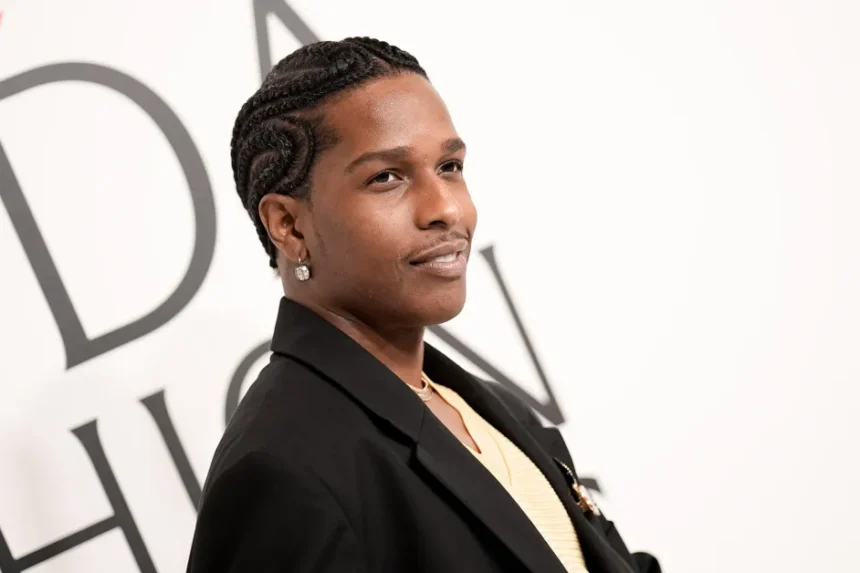
A$AP Rocky becomes the target of a special police unit in the SWAT TEAM video, released on October 21, 2026. The staged pursuit develops toward a reversal as the rapper and his companions take control of the situation. Co-directed by Rocky and Arnaud Deroudilhe, the production combines action-film imagery, a fictional television broadcast and visual references to the artist's AWGE creative collective.
A$AP Rocky turns SWAT TEAM into a pursuit in which the people planning the operation lose control of its outcome. The video begins with a special police unit moving to locate and stop him, establishing the rapper as the focus of an organized raid. His character's reaction is unusually calm, creating a sense that the situation may not develop as the approaching officers expect.

Rather than appearing panicked, he watches events unfold with measured confidence. That performance becomes a central part of the narrative. The police move with the apparent certainty of a team equipped for a specific assignment, while the target behaves as though he understands something they do not. The contrast prepares the viewer for the later shift in the balance of power.
The pressure increases as the unit moves closer. Editing and character movement sustain the idea of a pursuit that could escape its organizers' control, while A$AP Rocky remains the story's center even when the camera follows the officers. The video therefore gives the action a direction beyond a sequence of unrelated images placed around the recording.
The turning point arrives when the rapper and his companions seize the initiative. The SWAT unit moves from pursuing to being overcome, reversing the positions established at the opening. The change involves the people around him as well as the lead character, presenting the outcome as a group response rather than a purely individual escape by the star.

Rocky shares directing credit with Arnaud Deroudilhe, giving him a role in shaping both the character seen on camera and the way the story is told. The collaboration treats the raid as a complete visual scenario, with an opening, a confrontation and a reversal. The action supplies a direct connection with the song's title while allowing the images to develop their own narrative.
Angelo Marques handles cinematography, with framing and movement contributing to the tension between the two sides. The photography has to keep that conflict readable as characters move through the operation. The result draws on action-film presentation, using the composition of shots as part of how the viewer follows the pursuit rather than as decoration detached from it.
Frenzy Paris produced the video, bringing together the crew behind the shoot and post-production. Editors Alexandre Sellem and Manuel Coutant worked alongside Deroudilhe on the final sequence. Their work links the different phases of the chase to the music, fitting a developing story into the running time of a track and sustaining momentum toward the change in control.
Disguys contributed to visual post-production, with Nolann Blettner supervising visual effects. Those technical roles form part of the wider work behind the finished imagery. Photography, editing and effects are combined within the same staged operation, supporting the fictional environment rather than presenting the images as documentation of an actual incident involving A$AP Rocky.

A television report inside the video gives the story another perspective. The fictional broadcast presents the central character as someone repeatedly targeted by SWAT operations. It briefly moves the account from the space occupied by the characters to a screen within that world, allowing the pursuit to appear through a simulated media treatment as well as through direct action.
The broadcast belongs to the fiction. It is not a real news report about an operation against the performer, and the raid is a scripted music-video scenario. Maintaining that distinction matters because recognizable police imagery and television conventions can otherwise make individual clips look detached from their setting. The exaggerated presentation is part of the character and story the directors have constructed.
AWGE references also appear within the visual environment. The creative collective associated with A$AP Rocky has connections with direction, design and the presentation of his wider artistic identity. Its identifying elements sit inside the fictional world of the video, tying the production to that creative history without replacing the pursuit as the central thread of the narrative.

The October 21 date refers to the official release of the video, rather than necessarily identifying the first release of the audio recording. The new production's focus is how SWAT TEAM moves onto the screen. Rocky's controlled presence, the collective response around him and the fictional report all contribute to the same progression from target to the person with the initiative. The track belongs to Don't Be Dumb, whose visual rollout also includes SHROOM CLOUDS. That wider setting places A$AP Rocky's latest directing contribution within an ongoing sequence of videos, rather than treating the release as an isolated film project.
The ending completes that reversal without turning the action into a factual account. A$AP Rocky begins as the subject of a planned police operation and finishes on the side controlling events. With Deroudilhe sharing direction and a wider production team shaping the images, the video carries the song through a staged chase whose decisive turn arrives when the pursuers lose their advantage.