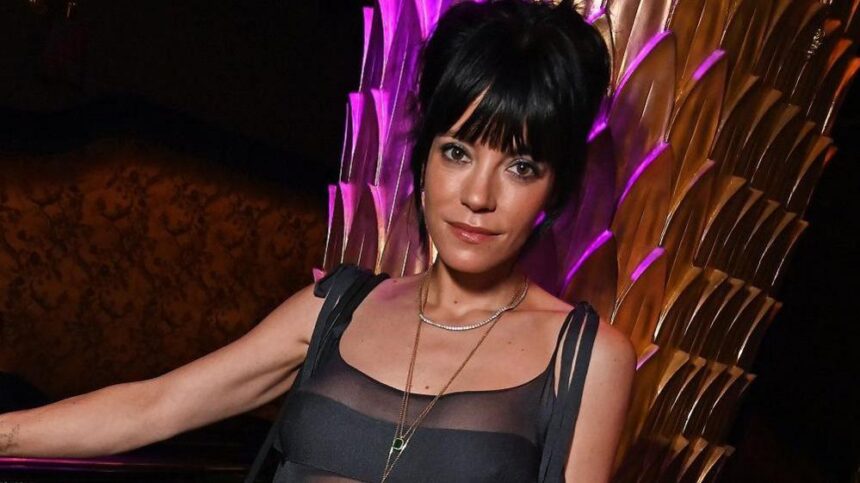
Lily Allen used Halloween to poke fun at ticket sales for her North American “West End Girl” tour, dressing as a Ticketmaster seating map covered in blue dots representing unsold seats. A white jacket, bodysuit and thermometer turned the online phrase “blue dot fever” into a costume after several concerts moved to smaller venues because demand fell below the original expectations.
A black panel marked “Stage” supplied the finishing detail to Lily Allen’s Halloween outfit. Around it, blue dots on white clothing recreated the appearance of a concert seating map. Her accompanying post needed little explanation: a short caption about never escaping the allegations appeared alongside the “bluedotfever” hashtag, connecting the costume directly with the online discussion surrounding ticket sales for her North American tour.

The joke draws on Ticketmaster’s interactive seating charts, where blue dots indicate available seats. Large clusters of them have become the basis for online comments about shows with limited demand. Allen’s thermometer completed the reference to a fever, making the phrase part of both the outfit and her pose. The costume translated a familiar ticket-buying screen into something immediately recognisable in a photograph.
Lily Allen was making fun of a discussion that had already produced practical changes to her tour. Several performances had moved to smaller venues, while the scheduled Montreal concert was cancelled. Those adjustments affected particular shows and their scale. They did not amount to the cancellation of the entire tour or the end of its production, which continued with revised arrangements in different locations.
Chicago provided the sharpest contrast. A concert originally announced for the United Center moved to the Chicago Theatre, shifting from an arena with a nominal capacity of approximately 23,500 to a theatre with around 3,500 seats. Those numbers illustrate the difference between the venues. They are not a count of the tickets sold for the specific performance and should not be interpreted as sales figures.

A comparable change occurred in the San Francisco area, where the concert moved from Chase Center to Oakland’s smaller Paramount Theatre. That adjustment changed both the venue and the city within the same broader region. Alongside Montreal’s cancellation, the move helped put demand under scrutiny. The specific decisions became the background to Allen’s Halloween response rather than an unrelated joke about the ticketing business generally.
When discussing the changes, Lily Allen acknowledged that ticket sales had not been sufficient. She said the original scale reflected promoters’ estimates, while she had raised doubts with her manager about whether the proposed venues were too ambitious. In her account, she asked whether he was sure about the plan before agreeing to proceed with the larger configuration suggested for that part of the tour.
She said the response was that these were the expectations coming from the promoters. That explanation describes how the initial venue decisions were made, but was not accompanied by a detailed date-by-date sales breakdown or financial accounting. Allen also noted that cancelling everything would affect more people than herself: approximately 50 production workers had expected employment through the tour and its scheduled performances.

Keeping shows going in rooms closer to the actual level of demand therefore also offered a way for the crew’s work to continue. Allen separately questioned the transparency of ticket availability, saying fans had told her about buying inexpensive seats on the day of concerts she believed had already sold out. She cited a $22 ticket as an example of information reaching her from audience members.
The singer said she did not understand the whole mechanism and suggested that someone had the answers, but the artist did not. Those remarks express uncertainty rather than proving a particular company engaged in wrongdoing. In the separate matter of her own tour’s venue changes, she had directly acknowledged that demand did not justify every room originally booked for the North American dates.
Behind the discussion of seats is a performance built around the complete “West End Girl” album, released in 2025. Allen performs the record with prerecorded musical accompaniment and limited conversation with the audience. She has defended the decision not to speak between songs, explaining that maintaining a fourth wall helps the narrative. That theatrical term refers to the imagined boundary separating the stage from its spectators.

The album draws on the breakdown of her marriage to actor David Harbour and explores tensions within a relationship coming to an end. This personal material also provides the centre of the stage presentation. Performing the record in full keeps its running order and developing story at the heart of the show, rather than interrupting that progression with the familiar exchanges of a conventional concert.
Despite the venue changes and debate about the format, Lily Allen has expressed pride in the production and the work of everyone involved. She has stressed that the touring team is working hard to deliver the strongest show possible. In her Halloween photographs, the response to the sales discussion became literal: she wore the available-seat dots herself, completed the seating map and held up the thermometer.