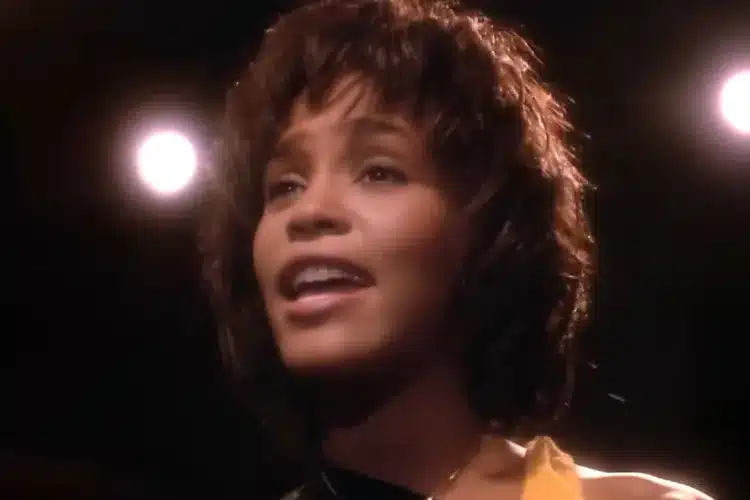
Whitney Houston earned her first Billboard Hot 100 No. 1 with “Saving All My Love for You” on October 26, 1985. Michael Masser and Gerry Goffin had written the ballad years earlier, and its first recording was a duet. Houston turned it into a solo performance that brought her a first Grammy and opened a run of seven consecutive American No. 1 singles.
When Whitney Houston sings the opening lines of “Saving All My Love for You,” she barely raises her voice. The woman in the song has learned to be grateful for a few private moments with a man who goes home to another family. Houston lets that arrangement register before the record builds. The force of the last chorus depends on how quietly she begins.

There was already a version of the song on record. Marilyn McCoo and Billy Davis Jr., the married former members of the 5th Dimension, included it on their 1978 album “Marilyn & Billy.” The two voices give that recording a different dramatic shape. A listener hears a duet even as the words describe a woman spending much of her time alone.
Masser wrote the music and Goffin wrote the words. The lyric puts the listener alongside the woman while she waits. Friends try to persuade her to find someone else. She has heard promises that the relationship will change and still makes plans for another night together. The title sounds tender on its own. Against those details it sounds like a decision she has to keep making.
Masser’s introduction to Whitney Houston came through another of his songs. Clive Davis, the head of Arista Records, urged him to hear her at Sweetwater’s in New York, where she appeared with her mother, Cissy Houston. Masser heard the young singer interpret “Greatest Love of All,” a song he had written with Linda Creed. By the time he worked on Houston’s debut, he had heard what she could do with a melody he already knew intimately.

The self-titled album arrived in February 1985. Masser produced several tracks, including both ballads. Their vocal demands were different. “Greatest Love of All” gives the singer a broad melody and a declaration she can make openly. “Saving All My Love for You” calls for a performance that can suggest confidence in one line and let doubt slip through in the next.
On the finished record, Whitney Houston approaches the verse almost conversationally. She takes the chorus higher, giving the title more weight each time it comes around. By the closing passage the voice is out in the open. The story itself is still unresolved, and that distance between the size of the vocal and the uncertainty of the relationship is part of what makes the recording linger.
Tom Scott’s saxophone takes over briefly where a second voice might have been. It gives the track room to breathe and preserves the sense that the woman has been telling the story to herself. Scott had recorded his contribution separately. He later recalled that Houston got his telephone number from Masser and called to thank him. The two had yet to meet.

Masser also remembered telling Gene Harvey, who worked with Houston’s management, that the ballad would give her a first No. 1. Arista issued it as a single on August 13, 1985. “You Give Good Love,” the preceding US single, had reached No. 3 on the Hot 100. Listeners already knew Whitney Houston could carry a hit. The next release asked them to spend four minutes with a much more uncomfortable story.
The ballad topped the R&B chart before it reached No. 1 on the Hot 100 in October. It began a sequence that lasted across two albums and ended with “Where Do Broken Hearts Go” in 1988. In the autumn of 1985, the immediate achievement was decisive for a debuting artist. A recording built around the voice and a patient arrangement had become the most popular single in the country.
The music video, directed by Stuart Orme and shot in London, gives the affair faces and places. The record leaves those images to the listener. Houston’s performance moves between the two registers. She can make the material feel like a scene playing out in front of us, then pull back enough for the next line to sound like a private thought.

McCoo later said that she and Davis rarely performed the song because audiences associated it so closely with Whitney Houston. Their earlier recording lets you hear how much changed when one singer was left to carry the whole conversation.
At the Grammy ceremony on February 25, 1986, Whitney Houston won Best Female Pop Vocal Performance for the single. She sang the ballad that night, and the performance earned an Emmy. The televised version offers another way to hear what Masser had responded to at Sweetwater’s. With the room watching, Houston starts the story in a voice pitched low enough that the audience has to lean in.